| |

Studies
in
Buddhadharma
On Samsâra
 Contents
  SiteMap

"Monks, this samsâra is without
discoverable beginning. A first point is not discerned of beings roaming
and wandering on hindered by ignorance and fettered by craving. What do
You think, monks, which is more : the streams of tears that You have shed
as You roamed and wandered through this long course, weeping and wailing
because of being united with the disagreeable and separated from the
agreeable - this or the water in the four great oceans ?" -
Samyuktâgama (Samyutta-nikâya) II 179.
General
Features of the Wheel of Life
The Wheel
of the Worlds
The Wheel of Dependent Origination
A Few
Considerations
|
|
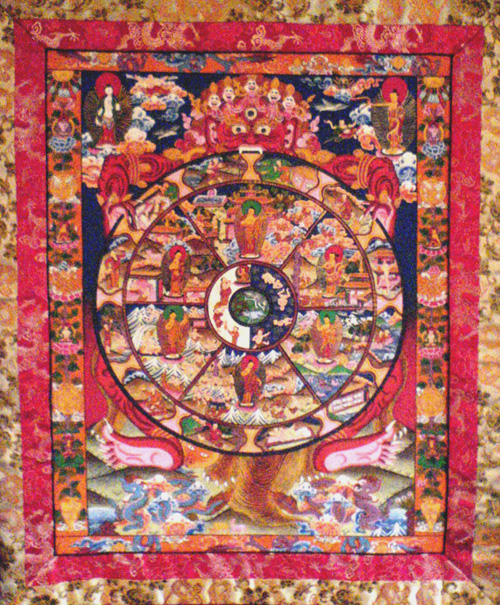
Tangkha of the Wheel
of Life (Bhava-cakra)
representing "samsâra" & its beings
ignorance, craving & hatred is at its hub |
|
|
"Samsâra" (from
prefix "sam", or "together" + the root "sri", or "to flow") or "that
which flows together" signifies the perpetual flux of existence
bringing subjects & objects together. It is the round of birth,
life, death, rebirth, renewed life, death, etc. determined by fate
("daiva"), the web of karmic indebtedness. Sentient beings
are entrapped in suffering. From another angle, "samsâra" is "mâyâ", the
measured mesh of illusions caused by ignorance ("avidyâ"),
misapprehending ourselves & the world as existing inherently
while such substantial stasis cannot be found. This root error keeps
the "causal nexus" and our spiritual blindness going.
Undoing this process is the goal of the path proposed by the
Buddadharma.
Also meaning
"wandering-on" or "journeying", "samsâra" is divided in three realms : the
Desire Realm, the Form Realm and the Formless Realm. These last two
realms are part of the world of the gods. "Samsâra" is the
technical term for the succession of rebirths a sentient being or
"samsârin" (migrator or worldling) goes
through within the various modes of cyclic existence until "nirvâna"
is entered.
In the view of certain Hindu schools, "samsâra" and "nirvâna" are
polar opposites. To enter "nirvâna", one needs to negate "samsâra".
The latter only ceases with the former's negation of it. Hence, they
cannot exist together. However, "nirvâna" is achieved by
understanding the real nature of "samsâra", not by negating
it. There is no "hierarchy" here. "Nirvâna" is "samsâra" devoid of
substantial instantiation. Both are therefore rooted in the mind. A
deluded mind exists in cyclic existence, while bodh-mind prehends
ultimate reality.
Merit ("punya") causes us to be reborn as humans or gods
of the Desire Realm ("kâmadhâtu"). The
concentrations & absorptions (or
so-called
unfluctuating -"âniñjya"- actions) lead to rebirth in the Form
("rûpadhâtu") and
Formless Realms ("ârûpadhâtu"). Both Form & Formless
Realms are part of the world of the gods.
The imprisonment in cyclic existence is caused by the three
unwholesome roots ("akuśala") : ignorance ("avidyâ"),
thirst or ignorant craving
("triśnâ") & hatred ("dveśa"). Ignorance is foremost a mental
delusion, whereas craving & hatred give rise to afflictive emotions
(representing exaggerated grasping at and exaggerated repulsion of
objects of mind). What
kind of rebirth a sentient being takes, is determined by the power of
"karma".
To know previous rebirths, one studies present conditions. To know
future rebirths, one again ascertains present actions (of body, speech &
mind).
Able to recognize the Three Poisons and make a definitive choice, human beings are the only ones
able to depart from "samsâra". Hence the precious nature of a human
birth within cyclic existence. Other beings are so overwhelmed by
the conditions of cyclic existence pertaining to their realm,
they cannot make a positive choice against them and so remain stuck
there for very long periods of time, with little opportunity to for
a higher rebirth (especially so for hell-beings, hungry ghosts &
animals, the three lower realms). |
The Wheel of Life, the first
Buddhist example of the mandala model, represents cyclic existence and is
widespread in Tibetan Buddhism (it often hangs at the entrance of the
"gompa" or temple). According to one story, when King Bimbisara of Magadha
(ca. 558 - 491 BCE) sought a portrait of the Buddha to give to his ally
King Udrayana of Vatsa,
Śâkyamuni suggested to design the gift himself.
Various artists were employed under his direction, resulting in the Wheel
of Life, providing a digest of his teachings. It represents the realm of
"samsâra" as a whole, but can also be viewed as a mindmap. To teach, so another tale
goes, he drew the outlines of the wheel with grains of rice.
Scholars conjecture the "Wheel of Life" was the work of the
Sarvâstivâdin School.
The
use of pictures illustrating the wheel is attributed to Nâgârjuna.
This mandala is a pictoral summary of the
Four Noble Truths,
the core of the Buddhadharma :
-
the truth of suffering
: diagnosis : caught in & trapped
by the cycle of rebirth,
all sentient beings, from hell beings to gods, suffer ;
-
the truth of
arising
: etiology : ignorance, ignorant craving and
hatred, make the hub of the Wheel of Life turn & rebirth continue -
they case suffering ;
-
the truth of cessation
: curability : by following the path of
virtue, the
Noble Eightfold Path, the suffering of all sentient beings can be ceased ;
-
the truth of the path : therapy : by
reversing the twelve links of co-dependent arising, ignorance (the first
link) is eliminated, suffering vanishes and so enlightenment becomes a fact.
Depicting the citizens of the Six Worlds,
the Wheel of Life is the anatomy of the mind's reactivity, the expressions
of the habits of the reactive, suffering mind causing suffering for a vast
number of sentient beings, all overarched by death.
General features of the Wheel
of Life.
Making it turn without stopping,
the circle of poisons at the hub of the wheel has a black pig (ignorance),
a red cock (the whole spectrum of afflictive desires) and a green snake
(hatred coupled with aggression). These are called the "Three Unwholesome Roots", for all
possible suffering
grows from them. They are the "Three Poisons" corrupting us from within.
The two
afflictive, complementary root-emotions (craving - hatred, grasping -
rejecting, attraction - repulsion, lust - unlust, etc.) are emotional elaborations
from mental ignorance, the superimposition of a reifying concept on reality (in
these cases, of an independent self, existing in and of itself, as it were
standing alone). Indeed, emotions are coarse manifestations of mental
states, namely those co-relative to biological activity & gratification.
Emotions range from lust to unlust.
This spectrum of non-afflictive & afflictive emotions, charging the
energy-body (or subtle electro-magnetic & etheric field surrounding the
living physical body) with the traces of this monkey-mentality, constitute
the "existential dialectic" or "fire" of "samsâra", its constant pain. The
"fuel" of this fire is the conviction sensate objects (those attended by
the five sense-consciousnesses) are, on the one hand, self-settled,
self-powered and "causa sui" (independent) and, on the other hand,
unrelated (in some essential aspect) from other such objects (isolated).
Independence is akin to desire ("I want this and that."), while isolation
resembles hatred ("I am not this or that."). Independence & isolation are
the "classical" assumptions about objects held by the advocates of
conventional truth. The latter is valid but mistaken, i.e. logical &
efficient, but conventional objects do not appear as they truly exist.
Ignorance is precisely being unconscious of the truth-concealing, mistaken
& deceptive nature of objects, be they sensate or mental. Take away this "avidyâ" and the afflictive emotions are
rooted out. Then the wheel stops to spin. The motive force driving the
wheel at its hub has been countered. Again the solution or soteriology is
defined in terms of a science of mind.
This
innermost circle is surrounded by the circle of
karma, half white & half black, representing the two paths
possible after physical death : a higher rebirth caused by a virtuous life
("kuśala"), either as a human, demi-god or god, and a lower rebirth as the result of non-virtue ("akuśala"),
harsly suffering as a hell-being, hungry ghost or animal.
Saints guide the virtuous up the white path, headed by the ideal of the
Buddha and his supramundane enlightenment. On the black path, demons,
armed with nooses, drag the ignorant downward into the hells. Buddhas &
Bodhisattvas, adorned with great skill & wisdom, appear everywhere,
allowing all sentient beings to recognize their Buddha-nature and enter "nirvâna".
The Three Poisons drive sentient beings through the Wheel of Life, causing
causing constant suffering, unsatisfactoriness, lack of bliss. From a
transcendent (nondual) perspective outside the wheel, both up and down lead to more suffering !
The wheel of karma is surrounded by the large circle divided in
six worlds, representing the realms of "samsâra" : namely hell beings
(bottom),
hungry ghosts (bottom-left), animals (bottom-right), humans
(upper-left), demi-gods (upper-right) & gods (top). The three worlds
at the bottom are the worlds of inferior rebirth (hell, hungry ghost &
animal), while the top half represents the higher rebirths (human,
anti-god, god). Inferior rebirth is terrible and endures for a very long
time. The conditions here are so harsh, that no upward thrust can be
accumulated. Higher rebirths are less hard and so enable a surplus leading to a human rebirth (and
so to enlightenment). All the countless world systems inhabited by sentient
beings are contained within these realms. The Form & Formless Realms are
part of the world of the gods. But the God of Death, Yama, ruling the six
realms of cyclic existence (devouring the wheel) is the final arbiter. All
sentient beings die. Even the gods ultimately perish ! In the Mahâyana,
this terrible deity is a wrathful manifestation of the Buddha of
Compassion.
Originally, demi-gods & gods were pictured
together. Later developments, initiated on the authority of
Tsongkhapa (1357 - 1419), depict six divisions hand in hand with
the six forms of
Avalokiteśvara, the Buddha of
Compassion, taking away the suffering of the all types of beings, bringing
them to enlightenment ! He is "Padmapāni", or "Holder of the Lotus" and
manifests as a "mahâsattva", a Dhyâna Bodhisattva above the seventh ground
("bhûmi"). His activities are evoked by the practice of "Turning
the Wheel of Compassion". As the complex conditions for enlightenment only
pertain in the human realm, this practice is profound & extraordinarily
beneficial. Indeed, with the
help of Avalokiteśvara, beings of all realms may find true peace without having to first
reincarnate as humans ! Hence, the great compassion of the Buddhas supersedes the
natural logic of "samsâra".
The power of the Buddhas, although not omnipotent, is supernatural.
The rim of the Bhava-chakra mandala has the clockwise wheel of the twelve links of
interdependent or co-dependent arising ("pratîtya-samutpâda"),
of which the first is ignorance, cause of all suffering and subsequent
afflictive activity. Reverse the first link, and the chain of co-dependent
enlightened activity emerges. These links remind us of the Zodiac,
representing the twelve stages of the process of manifestation, the logic
of dependent arising. Indeed, the clock of twelve suggests the "book of
wisdom" of all possible views on the universal interconnectedness of all
possible (sensate & mental) objects.
The whole mandala is clutched by Yama, the Lord of Death, a form of the
Buddha of Compassion, indicating nothing permanent is to be found in
"samsâra". At some point, all sentient beings meet death. At the top right
we find the figure of a Buddha, indicative of the Buddha-potential present
in all sentient beings, recognition of which is the only thing required
to awaken. At the top left stands Avalokiteśvara in the form
of a Dhyâni Bodhisattva (the Buddha of Compassion taking the form of a
Mahâsattva Bodhisattva). He beholds all the suffering of cyclic existence,
offers antidotes and represents the drive within "samsâra" to fulfill
itself in the transcendent nature of "nirvâna".
The specific images & iconography of this didactic device have been
preserved & developed in Tibetan Buddhism.
The Wheel of
the Worlds.
The six worlds represent (a)
actual locations on the subtle, invisible planes of "samsâra" (cf.
hylic
pluralism) and (b) actual afflictive states of mind causing the suffering
predominant in each world. None of these worlds, not even heaven & hell,
are permanent and all sentient beings journey from one world to another.
Dying, they enter the "bardo" or "interval" and swirled by their "karmic
winds" they enter a realm seeking rebirth.
|
REALM |
COLOR |
DELUSION |
PERFECTION |
MANTRA |
| Gods |
white |
pride |
concentration |
OM |
| Demigods |
green |
jealousy |
ethics |
MA |
| Humans |
yellow |
craving |
joyous effort |
NI |
| Animals |
blue |
stupidity |
wisdom |
PAD |
| Ghosts |
red |
greed |
generosity |
ME |
| Hell-beings |
black |
hatred |
patience |
HUM |
Each world is associated
with an afflictive root-delusion, a perfection, a color (usually not
visualized as bright but rather as dull & dirty) and a syllable of the
mantra of Avalokiteśvara "OM MANI PADME HUM", or "OM, the Jewel
in the Lotus, HUM".
THE INFERIOR REALMS
1. Hell-beings cherish
denial.
I do not want the pain
I'm in.
Of all beings of the Desire Realm,
hell-beings suffer most. Two major types are listed : eight hot & eight
cold hells. All hot hells are visualized as composed of burning iron and
all cold hells are dark & cold with snow falling and snow storms. A
sense of enduring crushing blackness rules. The Lord of Death is also depicted
there in the form of a terrifying judge, counting the good & bad deeds of
the dead in the form of white & black pebbles. If black prevails,
horrible rebirths ensue.
These hells are arranged on top of each other and each of them, in each of
its corner, has four neighbouring hells. The latter are the same for each
hell, and so if one understands the neighbouring hells with respect to one
hell, one understands them with respect to the others. Hence, the number
of hells is sixteen times eight times two or 256 hells. From mild to
severe, the hot hells are called : Reviving, Black Line, Crushed Together,
Crying, Great Crying, Hot, Very Hot, Most Torturous. The cold hells are :
Blistering, Bursting Blisters, Groaning, Moaning, Chattering, Split like
an Blue Lotus, Split like a Lotus, Split like a Great Lotus ...
This scheme points to the variety of ways sentient beings "block out"
certain parts of their consciousness and choose to exist in denial. These metaphors
of pain are indicative of the strong habitual repulsions involved. They
are also part of the Ancient Egyptian, Judeo-Christian & Islamic imaginal.
Sharing the connotations of recurrent pain, agony & suffering in the hands
of merciless, sadistic torturers (representing the hate-potential of our
own minds), the Buddhist hells are however clearly
unlike the Egyptian & Abrahamic hells. Note this :
-
the suffering
is self-inflicted
: without Deities, One Creator or a Singular
Creator God, hell is not a punishment for disobeying God's Laws, but the
mere result of previous action - in the Abrahamic faiths, punishment comes
from God ;
-
the suffering ends
: because the result of any action exhausts
itself, the experience of hell is also impermanent and so ends. The hell-being
dies or is saved by enlightened action - the Semitic hells are eternal,
there is no escape and no salvation, the Devil cannot be converted, the
end is a duality, not a unity (or an unbounded wholeness) ;
-
salvation is
unlikely but possible
: the actions of an enlightened being
(Dhyâni Bodhisattva or Buddha) awakens hell-beings, while in the
West hell is irreversible ;
-
the hells are foremost mental :
although the hells are experienced as if they exist in a certain place (as
in a neverending nightmare), in reality they depend on conditions rooted in the state of our (afterlife) mind. The latter is
functionally co-relative with the progress made in this-life
meditations - in
the Abrahamic faiths, hell is also extra-mental, and given an inviolate
topo-ontological status in God's plan ;
-
the torturing demons are mental
: the beings torturing the hell-beings are nothing more than the
externalized factors of the minds of the hell-beings themselves, not
"demons" in service of Mâra (or a sadistic Satan).
The "hot" & "cold" nature of
these hells can be understood by meditating on the nature of hatred, the
root-delusion at work in all hells. Hatred always involves a very strong
emotional rejection, negation, turning away, dislike, etc. This comes in
two modes : stark indifference (cold) and violent rejection (hot). Dislike
is an absence of lust, a manifestation of unlust closing down every
possible authentic communication and bringing in a limited, restricted,
narrowed view in which one tries -in an attempt to excommunicate, banish
or exorcise- to catapult the rejected
event, situation or person out of one's environment. Coarse hatred is often violent &
extravert, while its subtle forms are indifferent & introvert, the
rejected object remaining hidden & unspoken. Such hatred is more difficult
to detect, although it too has the outstanding characteristic of
rejection, negation & dislike.
As in daily life, hatred may manifest in
meditation as a tendency to rudely push
away or repressing arising afflictive thoughts & feelings instead of accepting
their
presence, gently bringing our attention back to the object of meditation
and letting dark clouds last as long as they naturally move away without
any effort from our side. Instead, one focuses on them and tries to
eliminate them using strong denial. This unskillful antidote causes the
affliction to be fed by this denial, allowing it to become stronger.
Although the outcast entity seems gone, it has only moved to the
unconscious, feeding our shadows, and returning in other forms to harass.
In the case of hell-beings, the denial of reality is so intense, the mind
breaks down and a psychotic split occurs. When the hell-being sees its
torturer reaching for the red iron again, the denial is like a reflex and
instead of recognizing the torturer as the power of one's own past strong
rejections, as in patience, the sadist is identified as the cause of future suffering and
again denied, completing the circle and making the experience of hell
continue ... Future suffering should never be denied but recognized for
the impermanent phenomenon it is. Such recognition is the beginning of its
end.
Patience & acceptance are the antidotes to hatred. Instead of pushing away, one accepts
whatever happens and remains unmoved by the presence of negative rejection
or cold indifference. The violence is countered by not engaging in any
kind of negative counter-measure, but by taking the time, waiting for these
things to move away by themselves. Indeed, by not feeding hatred, patience is
the final victor.
The Buddha of Compassion appears in the form of a Bodhisattva with a
flame, bringing light & hope in these darkest of regions, showing fire can
burn but also purify, bringing these tortured beings closer to the Dharma.
He is also seen as bringing water to the thirsty and warmth to the cold.
The reasons why a hell-being suffers (namely its accumulated negative
karma) is not measured. At hand is the way out for this being. This
happens through highly skillful means, namely the "perfection" or antidote
associated with every realm, in this case patience.
2. Hungry Ghosts indulge in
miserliness.
I need to have, but
never enough !
The abode of the hungry ghosts is
described as a place with no grass, trees or water, just like a hot desert,
explaining the predominant color, dull red. These beings of displeasing shape have large stomachs and weak, thin arms
& legs. They have great difficulty finding something to drink or to eat.
Tradition makes three divisions : ghosts with external obstructions, those
with internal obstructions and those with obstructions with regard to food
and drink. The first type looks in the distance and sees groves of fruit
trees & large lakes and other various kinds of food and drink. They
try to reach for these, but either they cannot use them or they are
guarded by fierce protectors. The second type have knots tied in their
necks or very small mouths & necks or fire burning in their mouths. Even
if they have food & drink within reach, they cannot make use of it. The
last type have their food & drink changed into filth, burning iron or
molten bronze, or eat their own flesh. In winter, when the Sun shines on them, they become cold and,
in summer, when moonlight touches them, they
even become hotter. A life of ongoing misery, poverty, destitute.
Hungry ghosts spend all their time thinking about food and drink, but
remain hungry and thirsty for extended periods ...
Hunger & thirst are metaphors for unsatisfied ignorant craving and linked with the
root-delusion of greed. Keeping from others one's own surplus out of fear
of poverty, making others suffer to satisfy one's own needs, keeping from
oneself what is needed for one's own happiness, overindulging oneself in
satisfying one's needs, etc. are based on a poverty-mentality. This
painful state of mind can be present irrespective of wealth or the
possibility to satisfy physical & psychological needs. The fact wealthy
people are very often afflicted by this poverty-mentality proves the point true
peace
is foremost based on internal conditions.
The mental state of poverty dictates inferiority, worthlessness and a
sense of not being "good" enough or worse, basically bad, guilty, laden
with sin and without positive potential. These kinds of attitudes cause
the neurotic state of the "hungry" ghost. One is displeased because the
object of one's need is absent and when it is present one is displeased
because one does not really enjoy it while it lasts, constantly
anticipating the end of the treat. Instead of being delighted when a need
is being satisfied and not worried when satisfaction is not (yet)
possible, one cannot stop craving as long as the pleasure is grasped and
cannot stop anticipating the finish while the craving is being attended.
As a result, one is never truly satisfied with anything and/or anybody.
The antidote is to practice generosity. Giving away what only seems
needed, giving away for the pleasure of another person's happiness,
sharing with others while satisfying oneself, allowing oneself to be
satisfied and being aware of what truly satisfies and what not, etc. run
against this poverty-mentality afflicting the greedy person. Being aware
of one's potential, eliminating the pressures of irrational guilt and
inferiority open the mind to its natural potential : the original Clear
Light mind of Buddhahood.
The Buddha of Compassion appears in the form of a Bodhisattva with a
symbolic treasure box. Filled with spiritual jewels (the "gifts of the
gods"), he generously distributes them so the hungry ghost
craves for the Truth (Dharma) instead for food, drink & other material
pleasures. He ends the constant need for food by feeding them the Dharma,
in particular the realization also the poor sleep on a treasure (namely
their unmistaken Buddha-nature).
3. Animals follow instinct.
I want food, shelter,
sex & a territory.
Traditionally, the third
"inferior" realm of "samsâra" is that of the animals, suffering from
stupidity, caused by latent mental bodies, i.e. the dormant capacity to
conceptualize and think.
Because only sentient beings can enter "nirvâna", physical entities,
minerals & plants were omitted from the scheme. But insofar as the four
elements (Earth, Water, Fire & Air) constitute the physical world, they
may be included as earlier, preparative stages of development. In this
way, the animal world includes the vegetal and mineral kingdoms, while the
latter includes the physical realm of atoms, forces, architectures &
momenta. In an even larger sense, this realm encompasses our "blue planet"
as a living whole (cf. the Gaia Hypothesis). This is therefore the realm
of living Nature.
Three types of animals are distinguished : those living in water, those
scattered about the surface of the Earth and those flying around. Animals
suffer in various ways : of cold, of heat, of being crushed one on top of
the other, of hunger, of thirst, of fear of being oppressed and/or eaten
by other animals and of being used as beasts of burden. But the root of
this is a vast mental obscuration caused by the absence of any developed
conceptuality and the concordant sense of time. Living in a dull sense of
the here & now, they have only their short-lived emotions, instincts &
reflexes to guide them.
Stupidity can be countered by wisdom. To teach animals and slowly develop
their latent mental bodies, the Buddha of Compassion appears in the form
of a Bodhisattva holding a book in his hand. The book is the "code of
life", the edifice of the vast interdependence between all things. Wisdom
is understanding how all things are interconnected and grasping this
dynamism leads to an insight into things as they truly are, i.e.
process-like instead of substance-like. The natural world shows how all
things depend on other things.
This world refers to the ecology of the Buddhadharma. All sentient beings
are involved, and by including animals, the whole natural order is aimed
at and incorporated in the ontological scheme.
THE SUPERIOR REALMS
4. Humans exaggerate desire.
Yes, I want this, no,
I don't want this but that, etc.
Characterized by freedom of
choice, the human world is defined by an exaggerated desire or attachment
(clinging). Imagining worldly pleasures will ever truly satisfy us, is
nothing more than being attached to them, not seeing them for what they
truly are. Positing eternal supramundane Deities or Saviors, fixates the
error of attributing substantial meaning to objects of thought. Although outside pleasures exist, they are never lasting. Even those
humans able to satisfy their pleasures find no true peace in them.
After arising, they abide for a while, and then vanish to make way for
another cycle, etc. Thus countless cycles pass by and, at some
point, the experience becomes a bore. As cyclic existence is vast, this
may take a while !
Although they fail, humans entertain a constant attempt to maximize
pleasure (lust) and minimize pain (unlust). However, no wordly pleasure
can be made permanent, whereas the unpleasant cannot always be avoided.
Hence, for most humans, existence is a constant mixture of wants and don't
wants, never a stainless experience of everlasting bliss. Their "worldly"
wisdom teaches them to accept this situation, deluded to think a radical
change is not possible or lacking discipline to put in the right effort. At the end of
the day, when the first gray hears appear, the presence of unhappy
instances are reluctantly accepted along with the happy ones, becoming
fewer. Although
endowed with worldly "wisdom", mature humans feel powerless to
counter their unhappy situation, condemning themselves to emotional
mediocrity, swallowing their "happiness pill" as soon as the downside of
the natural process of afflictive emotions manifests itself again & again.
As a result of our exaggerated, afflictive cravings, we constantly vacillate between
four pairs of opposites, defined as the Eight Worldly Concerns : gain &
loss, fame & disgrace, praise & ridicule, elation & sorrow. If any
spiritual progress is to be made, these concerns have to be eliminated. As
long as we dislike loss, disgrace, redicule and sorrow and like their
opposites, we trap ourselves in constantly changing emotional & mental
states. As a result, we are dissatisfied, even when confronted with the pleasurable
side of worldly things ... Frustration is the outcome of our
vacillation and so we may ask ourselves "What will truly satisfy me ?",
motivating our spiritual quest.
Renunciation is not self-mortification. To stop the afflictive nature of desire, we need, instead of
constantly replacing displeasure with pleasure and experiencing how pleasure
makes way for more suffering, to investigate what gives us lasting pleasure.
The Buddha affirms this is possible, even in this life ! This heralds the beginning of the spiritual path. Only humans, given their
freedom of choice, are able to truly progress in this. Hence, a human
birth is an extraordinary opportunity and so precious.
Renunciation needs to be trained and to train it, we need diligence or
joyous effort. Humans often hope somebody else will do the job for them.
But this is not so, as history shows. Only by our own effort can we change
the negative emotions & mental patterns causing our own suffering and trigger
the manifestation of our resident Buddha-potential. To counter the bad
habits entrenched in our biological, emotional & cognitive make-up, we need
to practice. Nothing else will allow us to realize lasting true peace
hic et nunc.
The Bodhisattva of Compassion appears as a
monk with a begging bowl & a staff, suggestive of renunciation, the way of
non-attachment and the effort needed to realize it. This image also
reminds us of the fact worldly pleasures do not bring about lasting
happiness, ending suffering permanently.
5. Anti-gods keep a fortress
mentality.
I will do anything to
get what I want.
The anti-gods or "Asuras" are power-seekers trying to
get what they want by using aggression, force & domination. Their realm is divided
from the heavens by the "Wish-Fulfilling Tree", rooted in their realm but
bearing its fruit in the world of the gods, i.e. somewhere else ! By chopping the tree down, the
anti-gods try to get at the fruits. In vain. Because of their ambition, envy &
green-eyed jealousy, they spend their time without respite in competition
and warfare with the gods, never considering their religious training.
Similar to the gods, these demi-gods appear & behave like them, but
contrary to them, they always loose against them. Because of
their relentless activity and disregard for spiritual work, they are at
times included in the world of the animals.
Once an anti-gods, using force, realizes his or her gain, he or she runs the
risk of being the victim of another anti-god trying to take away what was
taken. An endless, competitive cycle is created, and by constantly
defending whatever is gained, they create a fortress mentality, closing
themselves to others, considering others as a danger. Loss of
communication causes a putrified state of mind, unable to consider
anything else than keeping what was taken and taking more than
necessary.
The anti-gods painfully point to the futility of competition and warfare as
a means of finding true peace, for whatever is gained has to be constantly
defended and is usually again lost to other evildoers. Their root-delusion
is jealousy, the inability to accept another possesses the better good.
Ethics is the antidote. The demi-gods must realize they cannot succeed
because their intentions are afflictive and retribution cannot be avoided,
either in the sense of loosing the cherished good or because there is
always some god more powerful and/or more blissful, or because the balance of
justice can not be avoided and evildoers are always punished.
The Bodhisattva of Compassion holds a sword,
the symbol of justice, pointing to moral retribution & inviting
the demi-gods to seek understanding and cutting through to insight rather than power ...
6. Gods endulge in heavenly
bliss.
I have everything I
want, no need for more !
Above the demi-gods are the six types of gods of the
Desire Realm. They are the Four Great Royal Lineages, The Thirty-Three,
the Joyous (where Maitreya lives), Without Combat, Enjoying Emanation &
Controlling Others' Emanation. Above these six are the seventeen divisions
within the Form Realm. These gods are free from the type of desire ruling
the Desire Realm, but they still have desire for visible form (colour,
shape), sounds and objects of touch. They experience no odours or tastes. The
four main areas of the Form Realm correspond to the four
concentrations or absorptions causing
rebirth there or awakening.
Above the Form Realm is the Formless Realm, separated from
attachment to both Desire & Form. There are also four levels in the
Formless Realm. In this realm there is no case of one being seeing another
being
or conversing with another. Here Divine aloneness is complete.
The heaven of the gods is a temporal realm of bliss
achieved by good deeds. These Divine beings constantly enjoy inexpressible joy
and so much endulge in this, they create for themselves the illusion of
the eternity of their paradisiacal state. Because of this strong &
extremely pleasurable condition, there is little to no reason for them
to look beyond their comfortable and carefree existence and undertake
spiritual training. Intoxicated by pleasure, they ignore harsh realities.
Considering themselves imperishable, they develop vanity,
haughtiness & pride. However, when their good karma is exhausted,
which is inevitable, they too are forced out of this state of heavenly joy to be
reborn again, and this per definition in less favourable circumstances.
Hence, the gods die a terrible death.
Their suffering resides in eventually realizing this situation, i.e.
understanding their error in thinking their condition as permanent. Seeing
their own demise, they are left behind by the other gods and suffer
terribly.
The antidote is meditation, in particular concentration. Genuine
experience of absorption proves one fundamental point to remember : heavenly bliss
ends. All is impermanent, even the gods !
The Bodhisattva of Compassion plays the lute,
reminding the gods of their limited pleasures, for just as the sound of
the lute is impermanent, so are they.
The Wheel of
Dependent Origination.
The "nidânas" or links of the
causal chain or "nexus" shows how all phenomena exist non-substantially
(not from their own side), in dependence upon conditions & determination
(causes).
Functional co-relativity, correlational interdependence, universal
interrelationality & interconnectedness, conditioned co-production, interdependent co-arising,
dependent origination, dependent arising ("pratîtya-samutpâda") are
all
synonymous. Even
Buddhahood is a dependent arising.
Although on an absolute (deep, implicate) level of reality phenomena are
devoid of substance (being
empty) and the distinction between
outer and inner (as well as all other dualistic distinction) disappear, on
a conventional (surface, explicate) level of reality, a functional and
thus "real" relationship of interdependence prevails. The dynamics of
phenomena is a "play" ("lila") or "sport" of interdependence. However, this
correlational interdependence is not viewed as the "substance" or
"essence" of the conventional world, as an "entity" or "law of entities"
on its own, for in the Buddhadharma, the links of dependent origination are known
in the emptiness of their fundamental, original, non-substantial nature, the
core of which is also empty (cf. the emptiness of emptiness). Emptiness
itself, neither dependent origination, should be reified. The chain does
not reveal the substantial nature of conventional reality, for the two levels (the
Two Truths)
are distinct. The
"substance" of conventional reality is non-substantial emptiness,
or absence of
inherent existence. This is the same as saying conventional reality is a
totality of interdependent parts.
The conventional law of the chain of dependent origination functions as a
result of the first link, ignorance ("avidyâ"). Take away ignorance and
enlightenment is a fact. A Buddha, who is omniscient, witnesses both
levels of phenomena simultaneously, i.e. understands all possible
conditions determining conventional phenomena hand in hand with their
fundamental emptiness. Experiencing emptiness only, a Buddha nevertheless
oversees all the interconnections defining every object and this
omniscience guides his or her liberating & awakening great compassion.
The twelve links are also used to designate the months of the year and so
are Solar. Hence, there is a correlation between these links and the
twelve signs of the Zodiac. They are the basis of astrology. In the sûtras, these
links or network of relationships are described as follows :
"And what, monks, is dependent origination ?
With ignorance as condition, volitional formations come to be,
With volitional formations as condition, consciousness,
With consciousness as condition, name & form,
With name & form as condition, the six sense bases,
With the six sense bases, contact,
With contact as condition, feeling,
With feeling as condition, craving,
With craving as condition, clinging,
With clinging as condition, becoming,
With becoming as condition, birth,
With birth as condition, aging-and-death, sorrow, lamentation, pain,
dejection and despair come to be. Such is the origin of this whole mass of
suffering. This, monks, is called dependent origination."
Samyuktâgama (Samyutta-nikâya),
IV 1-2.
The process of dependent origination is described by the twelve pictures
on the rim of the Wheel of Life.
Although variations occur, the iconography is quite stable. However, the
semantics of these links can be delineated in various ways :
-
ignorance
("avidyâ") : an old and sightless person with a stick :
as the origin of the cycle, ignorance is the root-cause of all suffering,
both mental & emotional.
Innate ignorance is a state of distraction & confusion caused by being
unaware of the true nature of phenomena. As a result of this ignorance,
one "imputes", "imagines" or "hallucinates" a dual world (divided in a
substantial subject & a substantial object), causing imaginary ignorance.
The man is unable to see, yet believes he can use his stick.
The small area covered by the stick is what the blind actually know, which
is very limited. Likewise, the ignorant invent a dual world, locking
themselves up within its narrow confines ;
-
volitional
(karmic) formations ("samskârâ") : a potter : throwing all kinds of pots on his
wheel, the potter represents the accumulation of conditioned,
karma-bearing actions or impulses, manifesting in body, speech & mind as a
result of ignorance. These can be virtuous (good karma), neutral or
negative (bad karma). The form of the pot is the result of the activities
of the potter. Too much or too little pressure makes an ugly pot.
Likewise, because the ignorant exist in their made-up reality & ideality, the form of
their experiences depend on their own activities, whether
physical, verbal (energetic) or mental ;
-
consciousness
("vijñâna")
: a tree and a monkey jumping from branch to
branch : the monkey seizes a fruit, plucks it and takes a bite
while another fruit catches its eyes. It dashes off towards it,
disregarding the fruit just plucked, swallowing it down in a hurry or
dropping it. At the
end of the day, there is a heap of half-chewed fruit left.
The jumping monkey represents the versatile, fluctuating, restless nature
of deluded, karma-striken, concept-bound consciousness ;
-
name & form ("nâma-rûpa")
:
a boat with two people : as consciousness expands, it labels things. This
name-giving is a form attributed to what appears, crystallizing phenomena
into designated sensate & mental objects or limitations, measurements
("mâyâ"). So the two persons represent mind & body, the two major
constituents of the individual ;
-
six sense bases ("śadâyatana")
:
a house with five windows & one door : the five senses (windows) and the
door (mental sense) are the portals enabling consciousness to communicate
(let in and let out), allowing it to commune with others, stepping outside itself
to interact with the environment. The windows access the "lower" (visible)
worlds, whereas the door of the mind offers an entry into the "higher"
(invisible) worlds ;
-
contact ("sparśa") :
a man
& a woman embracing : the meeting of the senses with their object is made
possible by the six sense bases, allowing physical interaction between
beings ;
-
feeling/sensation ("vedanâ")
:
a man with an arrow in his right eye : because there is contact between
beings, there are pleasant, neutral & painful sensations. The image
conveys the strong vividness evoked by the sense organs ;
The following two links tell us how we continue to create karma
conditioning the future :
-
thirst/craving ("triśna")
:
a woman offering drink to a man slaking his thirst : the repetition of
strong, afflictive emotions works addictive, and so conditioned by the
experience of contact with an object, craving can be for (a) pleasure, (b)
eternity, (c) existence & (d) annihilation (non-existence).
These continue to produce negative effects ;
-
attachment/grasping/clinging
("upâdâna") : a woman grasping a fruit : craving itself begs for
satisfaction and this leads to grasping or an exaggerated way to satisfy
thirst. Once grasping is firmly established, we do anything to have our
desires satisfied. Four kinds of clinging occur : (a) to sense pleasure,
(b) to wrong views, (c) to rules & rituals & (d) to the notion of a soul
or a self. These attachments cause an "automatic" form of rebirth, as by
reflex ;
The last three links point to issues related to this next life. They
underline the notion of rebirth (in other words, the continuity of the
continuum of consciousness, even after the demise of the physical body), making
mind beyond death an integral part of
Buddhist philosophy :
-
becoming/existence ("bhava")
:
a couple making love : conception occurs because during our previous
life we constantly fed our karmic tendencies, which have now ripened. The
conditions of our rebirth are thus determined by our karma, but conception
(the actual, gross materialization of our rebirth consciousness) is
determined by a couple making love. Rebirthing
consciousness is the result of past karma, arranging a new personality
around this kernel ;
-
birth/rebirth ("jâti")
:
a
woman in labour : the "newborn" is an "oldborn", carrying the karma of a
previous existence. The gross elements and the physical body are the
result of the imputing activities of rebirth consciousness. As a
result of this old karma, one is born in one of the six realms and of all rebirths in "samsâra", being born as a human
being with free choice offers the most opportunities for spiritual growth
;
-
old age & death ("jarâmarana") :
a man carrying a corpse : it is in the nature of all transient things to
end. Even gods die. When life-karma is exhausted, our gross body dies and
the subtle elements are peeled away until the naked, empty & luminous
nature of mind (the Clear Light of death) remains. This is the great
opportunity of death (balancing the dissolutions).
These twelve links may be
divided in three interdependent causal chains :
-
causal chain
from 1 to 7 : from ignorance to feeling/sensation
: describes the general dynamics from the original ignorant misconception to
the strong impact of the hallucinated world (actually from the root-cause
of delusion to the "now" of our afflictive experience or suffering)
;
-
causal chain from
8 to 9 : karma conditioning the future of events
: describes how
the hallucinated world brings about craving & clinging, the root-causes of
all future suffering ;
-
causal chain from
10 to 12 : karma conditioning rebirth
:
describes the continuity of future suffering, and the conditions causing
rebirth, i.e. the fact physical death is not the end of suffering. Ending
rebirth is the same as the total cessation of suffering.
Arrived at the "now" of our
painful, hallucinated, conventional existence (link 7), we can take our
future in hand or not. Hence the second causal group, spelling out the concordant
conditions influencing the future of events (link 8 & 9). If afflictive
emotions remain (the second causal group being ineffective), then the third
causal group comes into action : because of our past karma (link 10) and
some couple making love, rebirth happens (link 11) and the whole cycle of
suffering continues until we die (link 12), triggering another rebirth
(link 10), etc. ad nauseam !
|
01 |
ignorance |
01 |
prajňâ/vidyâ |
|
02 |
karma |
02 |
punya |
|
03 |
consciousness |
03 |
five wisdoms |
|
04 |
mind & body |
04 |
Nirmanakâya |
|
05 |
five senses +
mind |
05 |
Sambhogakâya |
|
06 |
contact |
06 |
Bodhicitta |
|
07 |
feeling |
07 |
compassion |
|
08 |
craving |
08 |
love |
|
09 |
grasping |
09 |
joy |
|
10 |
coming to be |
10 |
equanimity |
|
11 |
birth/rebirth |
11 |
upâya |
|
12 |
old age/death |
12 |
Dharmakâya |
The causal logic of this
interdependence can be reversed. This results in the above twelve links
leading to undeluded, true ("vidyâ"), enlightened consciousness.
As physical death only destroys the physical body and the subtle sheets,
the very subtle level of consciousness (the original mind, "rigpa" or
Clear Light) remains. Insofar as this is
recognized, enlightenment is immediate. By identifying
traces of ignorance & afflictive desires, this is often soon lost and transposed
to coarser levels (the "interval" of the intermediate state) until rebirth
(the "bardo" of rebirth) ensues. Normally, the whole process is quite automatic, and
not all too personal. One pays for the broken pots, but there are always
opportunities.
If there were no continuity after physical death, suffering would have a
natural, automatic end, which, according to Buddha, is a wrong view. Such
a view does not explain suffering and its continuity.
Without strong effort, we continue to cycle & suffer. The
power of dependent origination sustains our cycling without end. At a
certain point, we "meet ourselves", adjust, and the tiresome circle beginss
anew. This movement carries itself through, feeds its own momentum by our
ignorance, craving & hatred.
Then, at some point, we decide to change our
lot. This is an important moment, especially if nurtured and its intent
actualized. At this point, the cycle of interdependence can be used in
reverse. Eliminating the tendency to reify thoroughly, every moment of
consciousness is new, fresh and perfect.
A Few
Considerations.
Consider the crucial difference
between the spiritual philosophy of the Buddhadharma and the Egypto-Abrahamic West, relying on
divine kings, prophets, messiahs & saints, i.e. on a salvic onto-theology,
involving a "deal" or "convenant" with a Divine Being. One accepts
suffering cannot be eradicated alone and so one goes for refuge to the
Divine order, the heavenly worlds. Buddha entered these Formless Jhânas
and experienced how they too are unrealiable in irreversibly ceasing
suffering, but only succeed in this for a very very long time. The Third
Turning makes clear our Buddha-nature is the fundamental, original level
of our mind. This potential (in terms of philosophy) or enlightened nature
(in terms of direct experience) cannot be taken away. It is the guarantee
we can eradicate suffering without having to surrender to the gods or God.
The Buddhadharma accepts the presence of wrong views.
A Buddha is omniscient, not omnipotent. The Dharma is not a necessity without choice. The links are functional insofar as
conventional, afflicted experience goes. The logic of craving works by
concordant conditions, and each link brings to life the poignant stations
of this path, as well as its fruit (by reversing the chain). By attacking
ignorance, the root-cause will be affected, effectively making it
impossible for the resultant causes to abide. Again a science of mind.
Also note the root-cause is mental, not emotional. A mental error leads to
attributing independence & isolation to objects and this acts like oil on
the lust/unlust (rest-digest/flight-fight) fire of our biological
constitution, of monkey. First obscurations are at hand, not afflictions.
As long as the latter abide, too much noise distracts the mind to calmly &
regularly apply the necessary mental antidotes over some period of time,
like developing compassion, training in a conceptual understanding of
emptiness, doing emptiness meditations and adjacent practices, etc. So a
calm mind & a good heart come first. Then the ultimate nature of objects
can be analyzed without disturbing this peace of mind.
This emphasis on the condition of the mind in the context of spiritual
growth is philosophical, a "love of wisdom" encompassing the totality of
what is. It is not dogmatic, based on a revealed text. Again a sharp
difference with those spiritual systems based on sacred texts. The Canon
of the Buddhadharma is not sacred or revealed by itself. It may be
respected & revered, but that is another matter, dependent on the
practitioner(s).
Each dependent link offers a description of the conventional cycle of
painful hotspots human beings cause for themselves (and others) and is
flanked by an
antidote against the given afflictive desire or a craving :
|
01 |
blindness |
01 |
opening up |
|
02 |
wrong habituation |
02 |
creativity |
|
03 |
dull state of mind |
03 |
crisp, light state of mind |
|
04 |
duality |
04 |
dual-union |
|
05 |
labeling/imputation |
05 |
go out & see |
|
06 |
lust |
06 |
renunciation |
|
07 |
pain of contact |
07 |
cutting through |
|
08 |
addiction |
08 |
true enjoyment |
|
09 |
compulsion |
09 |
training |
|
10 |
impulse to return |
10 |
compassion |
|
11 |
a human birth |
11 |
ease |
|
12 |
fear of death |
12 |
acceptance |
The distinction between the
presence of "samsâra" and "nirvâna" exists in the mind
of the subject of
experience apprehending a deluded or a true object. There is no ontological difference between cyclic existence
and the ultimate state of true peace. As all phenomena (the ultimate noumenon
included) are devoid of own-power, all phenomena share the same ultimate nature. With our deluded, ignorant mind, chained to habitual
patterns, we fuel afflictive
emotions & mental obscurations and cause suffering to ourselves and others. We superimpose
inherent existence and react against our own projections. By becoming aware of
the true nature of things, we cut the root of suffering and end the cycle
of suffering.
This daring hypothesis every aspirant can test. It is not a dogma, but a
possible fact of experience open to scientific scrutiny.
When desire is afflicted, it turns into cruelty, greed, stupidity,
excessive attachment, jealousy & pride. After
liberation, there are no afflictions
left. This implies all desires (afflictive & non-afflictive) are
transformed into an intense physical & mental bliss experienced as empty.
Desires per se are therefore not the cause of suffering, but ignorant
craving is.
The Great Vehicle,
targetting
Buddhahood, is not against desire, nor does
not consider desire as without value, in particular in the context of
Tantra (Vajrayâna). The Buddhadharma identifies
craving & hatred as the root-causes of our suffering and dependent
origination explains how this happens and continues to be the case as long
as ignorance is not eradicated. As soon as this is a fact, one can take
great joy in all the virtues manifest in this world.

|
|



