| |

Studies
in
Buddhadharma
On
the Great Perfection Vehicle
 Contents
  SiteMap

"... if they see the
Tathâgata constantly present and not extinct, they will then become puffed
up and lazy, and unable to conceive the idea that it is hard to meet the
Buddha or a mind of reverence for him. Therefore the Tathâgata tactfully
teaches : 'Know, bhikshus, the appearance of Buddhas in the world is a
rare occurrence.'" -
The Lotus Sutra, chapter XVI.
The
Great Perfection Teachings
The Key in Three & the Ten Virtues Actions
The Two
Meditations & Eight Jhânas
The Mind of Enlightenment or
Bodhicitta
Self-cherishing & Self-grasping
The Four
Immeasurables & the Six Perfections
The
Ten Stages
&
Five Paths
The
Bodhisattva Vow
|
|
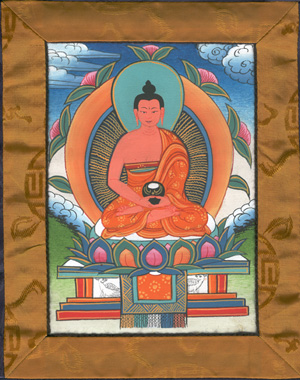
Tangkha of Buddha
Amitabha
with hands in the mudra of meditation |
|
|
The Great Perfection Vehicle,
"Pâramitâyâna", "Sûtrayâna", Transcendent Wisdom Vehicle or "Bodhisattvayâna"
is the
Mahâyâna path of the
Bodhisattva, leading him or her to the
bliss of Buddhahood. It entered on the world stage ca. 100 BCE, and developed parallel
with the
Lesser Vehicle. Its teachings are called
"Sutric" and contrasted with the later "Tantric" Vehicle. The latter is also
part of the Mahâyâna, but contested by some. The earliest Mahâyâna Tantras date from the early
2nd century CE.
Each time he turned the Wheel of Dharma, the Buddha set in motion a set of
functional & interdependent differences, i.e. Dharma energy.
Turning the Wheel of Dharma several times, the Buddha
created a wide number of methods (the so-called 84.000 Dharma-doors),
accommodating all kind of people.
There are Lesser Vehicle practioners who doubt whether the Third and
Fourth Turnings actually happened. For the Mahâyâna, these "higher"
teachings were given by the Buddha to selected disciples during his
lifetime (to be revealed much later) or bestowed to accomplished
meditators after he had entered "parinirvâna", becoming a Dharmakâya
Buddha . The latter view is akin to Tantra.
|
The Great
Perfection Teachings
Dating between 100 & 500 CE (for the non-tantric texts) or 1000 CE
(tantric texts included), about 600 Mahâyâna sûtras are extant, either in
Sanskrit, Tibetan or Chinese. In sensu lato, the non-tantric sûtras
of this body constitute the teachings of the Great Perfection Vehicle. In
sensu stricto, these teachings are identified with the Perfection
of Wisdom sûtras, the "Prajñâpâramitâ Sûtras", a series of about forty
sûtras, mainly dealing with the new wisdom ("prajñâ") taught by the
Mâhayâna. The earliest layer of this collection probably dates from the 1st century BCE (cf.
like the
Ratnagunasamcayagâthâ and the Astasâhasrikâ). In the West, the
Diamond Sutra and the Heart Sutra are best known. The best
approach is to take all schools into consideration, maintaining the
division between sutric and tantric Bodhisattvas (the latter use Deity
Yoga, the former not).
The path of the Bodhisattva is at hand, its nature & itinerary. The inevitable
preparation is nothing less than a long and hard training. The first stage
of the path involves accumulating
merit. Moral & spiritual exercises provide the shield of the
training. In a certain sense, the Mâhayâna focuses on the itinerary of the
Buddha before his enlightenment, i.e. when he was still a Bodhisattva,
giving away parts of his flesh to feed wild animals ! The
Hînayâna looks at what happened after his
enlightenment, defining what has to be renounced to live like the Buddha.
Indeed, the Mahâyâna aims at Buddhahood (awakening), considering it within
reach, while the Hînayâna targets Arhathood (liberation) and does not
consider it possible to realize Buddhahood in this world.
Due to this continuous practice, the method of the Bodhisattva culminates
in the generation of
compassion with the
mind of enlightenment for the benefit of
all beings, or
Bodhicitta. Because of
meditation on emptiness,
wisdom-mind increases and when
he or she has more than just conceptual understanding of
emptiness, but
actual, direct experience of it, then the first of the Ten Bodhisattva
Stages is entered. At this point, the ordinary Bodhisattva is a Superior
Bodhisattva. In each of the following nine Bodhisattva grounds, the Superior Bodhisattva must gradually
eliminate all subtle & very subtle obscurations & delusions or innate
self-grasping. Eventually, this ends in Buddhahood, at which point a Form
Body ("Rûpakâya" = "Sambhogakâya" + "Nirmanakâya") is taken to allow the
enlightened wisdom-mind (the "Dharmakâya") to work for the benefit of all
sentient beings.
However, reaching this lofty goal is full of difficult austerities, long
(three countless aeons) and arduous. Like the
Individual Vehicle, the Great Perfection Vehicle is
not a
quick path, nor easy at all ! Buddhahood is possible, but not very likely
as a this-life event. One then wonders how effective the
Buddhadharma can be ? If it takes so long to realize Buddhahood, then
truly helping sentient beings becomes a rare activity. Does this not annul
the intent ? The salvic goal of
the Great Perfection Vehicle clearly differs from that of the Lesser Vehicle,
for Buddhahood can indeed be attained (according to some Lesser Vehicle schools,
Arhathood and Buddhahood are not identical and only the former can be
attained). Nevertheless, a Sutric
Bodhisattva cannot say practice is comfortable or quick ! Hence, given
teachers are so scarce, sentient beings are likely to continue to suffer
for a very very long time. Was this Buddha's intent ? And if not, was he
not able to devise a method enabling a short-cut to "nirvâna" ?
Only by coupling the Great Perfection Vehicle with
Tantra
or Secret Mantra ("Guhyamantrayâna") can these difficulties of speed
& comfort be eliminated. Only when Sûtra training is strongly established,
eventuating in compassion and a thorough insight into
emptiness, is the horizon of Tantra
in sight. Without the former, the latter should not be entered, for
without
Bodhicitta the practice of Tantra leads
to worldly powers and a rebirth in the realm of the gods (of desire), not to "nirvâna".
As only a human birth, empowered with free will, enables one to practice, such a
rebirth, like all
non-human rebirths, is a
disaster. So we see the limitations of the Third Turning are solved in the
Fourth Turning. Without the latter, the Great Perfection Vehicle too stops
to be a truly effective means to help sentient beings in this degenerate
age. But without it, Tantra cannot be practiced.
The Key in
Three & the Ten Virtuous Actions
The foundations of the training protocol
for Bodhisattvas are detailed by schematic organizations of the world,
encompassing cosmology & psychology (object & subject), and concepts
related to the gradual progress towards enlightenment.
Theoretically, it is common to turn the fivefold
aggregates or heaps defining the human
being into a twofold :
| Aggregates |
Functions |
Body/Mind |
| form |
sensations |
body |
| feeling |
affects/emotions/feelings |
mind |
| compositional
factors |
will/volition/intention/etc. |
| discrimination |
thoughts |
| consciousness |
clarity &
awareness
luminosity & movement |
Note this Buddhist definition of "mind" is much more
extended than what is usually understood under mind in
Western epistemology. In the West, and
this since Descartes, the division between "res extensa" (the
extended thing) and "res cogitans" (the thinking thing) is
pertinent. For Descartes and rationalists after him (except Pascal) all
other factors, such as feelings, affects, will etc. are subsumed as an
instance of thought. Not so in Buddhism. Although in Hindu Yoga the mind
is part of the body (only "purusa" or "âtman" are set aside), Buddhism
clearly separates the physical body and the various functions. "Mind"
refers to cognitive, affective & volitional functions, as well as the
overarching luminous, sentient clarity of consciousness. Although Descartes also
speaks of the "natural light", he situates it before all possible
cognition and so it cannot be identified with the Buddhist notion of
consciousness, but rather with the underlying nondual Clear Light of the
original, natural mind
(Tantra).
In Buddhism, the mind merely gives rise to something, making
it into an object of engagement. It gives rise to things and apprehends
them.
The divisions introduced by Buddhist psychology are
helpful to grasp the process of
death & rebirth, as well as the various classification of
minds. The body dies, but the mind as a whole does
not. Buddha was clear. Although there are only heaps, rebirth is a fact.
So there must be a "thread" joining these consecutive rebirths. Tantra
explains how coarse & subtle minds
dissolve, but the very subtle mind, underlying consciousness, does not.
Buddha did not wish to speculate too much about these matters, for this
distracts practice. Nevertheless, if we eliminate rebirth from Buddhist philosophy,
then physical death becomes the natural end of suffering and not
"nirvâna". This contradicts the truth of cessation, for physical
death is a merely return of the biological organism to non-existence, while true cessation is
beyond any possible negation & any possible affirmation. Indeed, when
the body dies, the (very subtle) mind does not.
The very subtle part of a given mind continuum is the continuous "thread"
between rebirths. It may be called "âlaya-vijñâna"
when overlayed by obscuring veils or "âvarana" and samsaric imprints or
"samskâras" and "âlaya-prajñâ" or "âlaya-jñâna" when pure, i.e.
in the state of Buddhahood. However, this may be confusing, for in the
Mind-Only School -where this category is extensively developed- this
"storehouse-consciousness" points to an absolute, inherently existing
subject, and this conflicts with the Mâdhyamika fruits of ultimate analysis,
finding no inherent existent objects. For the Gelugpas, this very subtle mind,
devoid of afflictive imprints, is identical
with the precondition of enlightenment (or Buddha-potential) at the heart of
each and every sentient being, and experienced as the awake, ever-present, innate, spacious,
luminous clarity of the mind (of Clear Light). For the yogis, it is covered or veiled by the resonances of
previous, subtle & coarse actions. The latter exist on their own plane,
while the emptiness of mind is the
uncontaminated Body of Truth ("Dharmakâya"), as it were veiled or covered by these
imprints. This Body of Truth is empty of self, but not empty of something
(namely relationality and its own inherent enlightened properties).
This very subtle mind has the capacity to retain impressions
from previous actions (of body, speech & mind), allowing a Buddha to remember all his or her
previous rebirths. Due to their meditation on emptiness, causing the
transient dissolution of the coarse & subtle minds, Superior Bodhisattvas
may also remember some strong imprints of previous actions. Take away the very
subtle mind, and nothing survives the end of the physical vehicle, as
materialism conjectures. Without the very subtle mind, Buddhism is reduced
to a very elaborate spiritual psychology with a limited salvic result,
namely liberation from suffering in this life only. Such a motivation
assists personal liberation, but does not trigger the generation of
Bodhicitta.
Indeed, the "personality" defined by coarse & subtle minds dies with the body.
Only the very subtle mind of Clear Light, although empty and so not
independent or existing from its own side, is immortal, i.e. with a
continuous subtle form. By achieving Buddhahood, the very subtle mind
mounted on a very subtle body
becomes the Truth Body manifesting the Enjoyment Body, a perfect illusionary body apprehending
emptiness continuously. Right view recognizes the enlightened nature of
the deepest level of our mind. This
Buddha-nature or precondition of
enlightenment is a forteriori
already ours. All defilements can always be purified. This is the great hope offered by the Mâhayâna.
Our "sins"" are never bad enough to justify a permanent state of woe, like
the hells of monotheism. For the philosophers, this Buddha-nature is a
potential. For the yogis, it is the only inherently existing thing, a
Buddha-matrix.
To see the Clear Light after death is to enter "nirvâna".
This is the gift of death,
prompting us to properly prepare and directly
experience this light during life.
To practically situate Dharma in terms of the former division between
"body" & "mind", a threefold organization or "Key
in Three" is introduced :
| Three Jewels |
Three Gates |
Three
Vehicles |
Three Methods |
Three Ways |
| Buddha |
mind |
Dzogchen |
self-liberation |
Wisdom |
| Dharma |
energy/speech |
Tantra |
transformation |
Compassion |
| Sangha |
body |
Sutra |
renunciation |
Renunciation |
This division shows how important speech/energy is.
Speech reveals the subtle energy of the body. It can also be used to
invoke specific states of mind (as in prayers, mantra & recitation). When purified,
ordinary speech becomes enlightened speech or Dharma-in-action. This
explains why
Hearers were liberated by just listening
to the Buddha. This power of speech reminds of the
Great Word spoken by the
divine kings of
Ancient Egypt, the "Logos" as
"second God" in
Hermetism and the identification of "Christ", the "Son of God" with
the Word in
orthodox Christianity, although obvious
differences pertain.
|
psychological |
cosmological |
|
mind |
meditate |
fruit |
beyond Form &
Formless |
Dharmakâya |
Mother |
|
speech/wind |
reflect |
path |
Form/Formless |
Sambhogakâya |
Son |
|
body |
study |
view |
Desire |
Nirmânakâya |
Energy |
Bodhisattvas engage in virtuous actions and accumulate extensive
merit or non-samsaric "good
karma", i.e. actions leading to enlightenment, the escape from "samsâra"
(liberation)
and the realization of omniscience (Buddhahood).
These actions are paths leading to the transient happiness of higher
rebirths (as humans, anti-gods or gods), to the ultimate happiness of
liberation (Arhathood) or to awakening or full enlightenment (Buddhahood).
The Ten
Virtuous Actions are restraints from the
Ten Non-Virtuous
Actions founded on a clear recognition of its faults & dangers. So the
moral discipline of a Bodhisattva is to deliberately refrain from them.
They have fully understood their negative consequences, namely the depletion
of merit and so lack of accumulation. Not to
engage in any kind of non-virtue is not enough. One needs a firm decision
to abandon it and understand why this is so. This practice is not limited
to Buddhists. Everyone is able to practice this and establish this great
and vast discipline.
Mahayanists first generate the "mind of definite emergence" or
renunciation. The experience of suffering results from cyclic rebirth and
realizing this makes us wish to definitely leave "samsâra". This does not
imply rejecting or turning away from cyclic existence. While working with
conventional reality we accept both presence & absence of objects of
desire. We do not grasp at them, nor do we reject them. When what we long
for is absent, we do not worry. When it is present, we do not become
excited but know how to enjoy in a spirit of thanksgiving.
Eventually, while developing various methods to practice
renunciation, we wish to generate the "mind of enlightenment", i.e.
generate compassion for all sentient beings. Without compassion, our minds
are not supple and caught in self-cherishing rooted in self-grasping, or
attributing substantial, inherent existence to objects.
But before we eradicate self-grasping, we must eliminate self-cherishing by
"exchanging self with others", training the mind in that sense. When
Bodhicitta has been generated, we engage in eliminating the ignorance
caused by self-grasping and its Two Obstruction (to liberation because of
acquired self-grasping and to
omniscience because of innate self-grasping). Doing so, we enter the wisdom realizing emptiness,
culminating in Buddhahood.
The Two
Meditations and Eight Jhânas
Generally speaking, Buddhist
meditation is to familiarize our mind
with a meritorious object constantly & thoroughly. Concentrating on such
an object causes one to develop a peaceful state of mind. The bird of
meditation has two wings :
-
analytical meditation
: involves the purposeful process of investigating the meaning of
an object, usually Dharma teachings heard or
read. By intently analyzing the object from various points of view, inferential
conclusions are drawn, causing virtuous states of mind to arise.
Imagination, mindfullness and reason are used to do so.
Following Atiśa, these meditations are divided in three scopes : small,
middling and great :
Small scope meditations
: on our precious
human life, on impermanence, on death, on lower rebirths, on refuge, on
"karma" (actions and their effects) ;
Middling scope meditations
: on renunciation,
on birth, on sickness, on ageing, on death, on various sufferings ;
Great scope meditations
: on equanimity, on
mother sentient beings, on kindness, on equalizing self & others, on
self-cherishing, on cherishing others, on exchanging self with others, on
compassion, on taking & giving, on Bodhicitta, on the spiritual guide etc.
Analytical meditation helps the virtuous objects underlying the Dharma
teachings heard, read & reflected upon to rise, take root in the mind &
grow. By study, we understand the various individual Dharma teachings
heard and/or read. By reflection, we are able to confront these teachings
with one another and establish an larger, comprehensive view on Dharma, as
it were bringing the pieces of the puzzle together to form a whole. These
two steps involve the use of imagination & reason, and aim at a clear
representation of the Dharma. When reason has thus firmly grasped the
vastness of the Dharma, and cleared inconsistencies by the use of
logic & reasoning, analytical meditation allows, on the basis of such a
right view, virtuous states of mind to arise. These make the mind supple
and willing to move on, i.e. establish these virtuous states as objects of
Calm Abiding ;
-
Calm Abiding
or "śamatha" meditation : the virtuous states of mind generated by
successful analytical meditations are the objects of a single-pointed
concentration or placement meditation. We train to avoid distractions
disturbing concentration, holding the virtuous objects before the mind's
eye. When these thoughts and/or feelings fade, we return to analytical
meditation. Very deep levels of calmness are attained while concentrating
on an object firmly placed in the mind. Having found our virtuous object
through analytical meditation, we concentrate on it single-pointedly for
as long as possible. In this way, it becomes very acquainted & familiar. Eventually
we spontaneously mentally circumambulating it, contemplating its
interdependent possibilities with little or no effort. This happens with
increased inner stillness.
The total peace of mind of "śamatha" acts as the ground for the
development of
"special insight", empowering the mind to realize "vidyâ", wisdom & enlightenment.
First, a special type of analytical
meditation, called "Insight Meditation" ("vipaśyanâ"),
is used during balanced
placement to clearly see into the nature of subject (mind) and object
(sensate & mental objects), gaining a first-hand understanding of the way
things truly are, without reliance on opinions or theories. Then, at some
point, when
"special insight" or "superior seeing" rises, Insight Meditation automatically brings about
meditative equipoise. This finally empowers the mind to totally grasp
emptiness.
The process of Buddhist meditation thus involves three steps :
-
analytical meditation
: establishing a comprehensive right view on Dharma and generating
its co-relative virtuous objects ;
-
placement
meditation : complete concentration on the virtuous objects generated during
analytical meditation, causing the deepest possible calmness ;
-
Insight Meditation
:
analysis of the empty nature of self & others during placement in equipose
(the most advanced level of Calm Abiding), allowing one, on the basis of
"special insight" to completely mix one's conceptual idea of emptiness with
the object of placement, ending the Path
of Preparation, leading to the Path of Seeing (or the direct,
non-conceptual experience of emptiness).
Note calmness is a necessary condition for true insight into the
nature of phenomena. Without meditation, the mind will never be able to
know reality (the outer world of phenomena) and/or ideality (the inner
world of the self). Without peace of mind, genuine wisdom is impossible.
Without stillness, only one's own delusions are confronted, not the
fundamental nature of all phenomena, i.e. ultimate truth. Conventional
reality is the child of mental delusions generating afflictive emotions.
It cannot penetrate into the nature of things.
Although the Bodhisattva aims to realize final enlightenment to be able to
help others adequately, he or she trains the mind to experience the subtle
layers of "samsâra",
namely those of the Form and Formless realms, part of the world of the
gods. Eight absorptions are divided four concentrations and four
attainments.
The first "Four Jhânas" or "four concentrations" are the four stages of
cessation of the Form Realm approached with Calm Abiding :
-
the First Jhâna
: accompanied by discursive thought ("vichâra") &
conceptualization ("vitarka"), with joyful rapture
("priti") & happiness ("sukha") born of seclusion ;
-
the Second Jhâna
: with internal confidence & unification of
mind, without thought & examination, with inner calm, rapture and
happiness born of one-pointedness of mind or concentration ;
-
the Third Jhâna
: equanimous, without joy, mindful, alert,
aware and pervaded by happiness ;
-
the Fourth Jhâna
: neither-pain-nor-pleasure,
purity of mindfulness due to equanimity & wakefulness. At this stage
psychic powers are attained (clairvoyance, clairaudience, retrocognition,
telepathy & psychokinesis).
The mind trained in these Four Jhânas is concentrated, purified, wieldy,
steady, bright, unblemished, rid of defilements and imperturbable.
The last four formless ("ârûpya") absorptions of the Formless Realm,
approached with Insight Meditation, are "samâpattis"
or "attainments".
-
the Fifth Jhâna
(Infinite Space) : discrimination of forms completely disappears and there is no
longer any perception of obstruction & variety. In
this state, space pervades everywhere ;
-
the Sixth Jhâna
(Infinite Consciousness)
: consciousness is experienced as limitless and peaceful ;
-
the Seventh Jhâna (Nothingness)
: there is nothing formed or formless to be
apprehended ;
-
the Eight Jhâna (Peak of Samsâra) : by
letting go the sense of existence of nothingness, subtle discrimination is
left. There is neither perception nor non-perception.
The Bodhisattva trains in these absorptions for the sole purpose of having
a supple, clear, strong and willing mind. He or she does not wish to abide
on these levels, for doing so only engenders rebirth as a god, which is
not the aim.
Bodhicitta
Literally "awakened mind" or mind of enlightenment,
Bodhicitta is
the central notion of the Mahâyâna. Generating
merit by virtuous actions and/or realizing absorptions do not
fundamentally characterize the Bodhisattva. Non-Buddhist systems also
maintain moral discipline and develop spiritual exercises, involving
calmness and concentration.
Bodhicitta defines the way of the Bodhisattva.
It is said the Bodhisattva, like a good shepherd, vows to postpones his own enlightenment until
all sentient beings attain theirs. He or she enters "nirvâna" only after
the last sentient being has done so.
Why ? Because all other sentient beings are more important than one
sentient being. This is the intent. So to convey this universality of
compassion, the Bodhisattva makes sure he or she comes last.
It is also said the Bodhisattva is like a boatman, ferrying sentient
beings across, from conventional truth to "the other shore" of wisdom or
ultimate truth.
These admirable & devotional images, conveying vital information (namely
universality & process) nevertheless somewhat misrepresent the Bodhisattva's
true intent.
Does the Bodhisattva have the energy to stay last ? Is he or she able to
serve others without making sure he or she is also self-serving ? Not so.
No doubt extremely compassionate, powerful and wise, the Great Bodhisattva,
still under the sway of very subtle delusions, must first become a Buddha
to realize his or her goal. These logical considerations are important,
for the Buddha urged his followers to question themselves on everything,
his own teachings included !
True Bodhicitta is therefore "king-like". The Bodhisattva seeks full enlightenment
(Buddhahood) and then, as a Buddha, i.e. no longer a sentient being, brings infinite energy-resources into play to
help (teach, empower, bless) all sentient beings without free will (hell
beings, hungry ghosts, animals, anti-gods, gods) and all humans of good
will. While very powerful, a Buddha is not omnipotent, nor a Creator-God.
To propell into Buddhahood, the Bodhisattva vows to generate the "mind of enlightenment for all
sentient being".
According to the
Lesser Vehicle, the Great Vehicle miscalculates. Lacking time, the
Bodhisattva will never be able to complete his or her training. Liberation
(Arhathood) may be intended, but Buddhahood is extremely rare, if not
impossible. And in a certain way, Great Perfection Teachings confirm this,
for although Buddhahood is definitely possible, it remains extremely
difficult. To accumulate from scratch the necessary merit to clear all the
dross in a single lifetime was deemed nearly impossible.
This problem was solved by the tantric "turbo", increasing the accumulation
spectacularly, i.e. making available Bodhicitta and its compassion
generate very vast merit quickly. The two baskets (of merit and wisdom) thus
rapidly filled, enlightenment is possible in a period of time as short as
three months or a single lifetime ! In exceptional cases, a single
"pointing-out" instruction may suffice (cf.
Dzogchen).
By itself, this mind of enlightenment is the ultimate vehicle of vehicles.
But, once entering the "Body of Truth" ("Dharmakâya"), it is no longer necessary. Completing the
Ten Stages of the Bodhisattva training for the sake of the enlightenment
of all sentient beings is therefore the final goal of the Bodhisattva, the
first of which is entered when
emptiness has been directly perceived
during meditative equipoise
(the Path of Seeing). Then he or she is an "Ârya" or a Superior Bodhisattva.
Note a "turn of mind" is at the heart of the Buddhadharma.
In Tibetan Buddhism, relative & absolute Bodhicitta are distinguished. The
relative mind of enlightenment is subdivided in (a) the intention and wish
to generate this mind of enlightenment for all, called "aspirational"
Bodhicitta, and (b) actually doing so, called "engaging" Bodhicitta.
Absolute Bodhicitta is the vision of the true, fundamental nature of all
phenomena, the direct, undeluded experience of emptiness or suchness.
The way of the Bodhisattva is the appropriate means to generate
relative Bodhicitta, while the Ten Stages train the former to realize the ultimate
wisdom of absolute Bodhicitta.
To generate Bodhicitta, the
sevenfold instruction on cause and effect
by Aśanga is to be applied during
meditation.
Self-cherishing
& Self-grasping
All actions of body, speech & mind done with self-cherishing intention
cause suffering. This is the mind considering oneself more important than
others. Can we find a direct example of (coarse or subtle)
physical and mental painful contractions not directly or indirectly caused
by self-cherishing ? If nothing can be found, then self-cherishing is the
heart of (personal) problems, miseries and inner & outer faults. If so,
abandoning self-cherishing is necessary to enter the broader context of
acquired & innate self-grasping.
Self-cherishing is a mind dependent on self-grasping the "I", fully generating the
effects of discriminating between oneself and other persons in a way which
attributes (posits, imputes, designates) substantial, independent
existence to both oneself and to others. These effects are invariably
desirous attachment (craving) when sensating something attractive,
aversion (anger, hatred) whenever beholding the unattractive and
indifference for what is grasped as neither attractive nor unattractive.
These are the Three Poisons of affirmation (craving), negation (hatred,
denial) and ignorance from which all mental delusions and afflictive
emotions arise. These are the emotional afflictions to be abandoned by the
minds of renunciation, moral discipline & joyous effort.
Grasping at our own ego or self as inherently existing from its "own
side", we also grasp at the ego or self of others as substantial &
independent. Hence, the sense of selfhood integrates the view of
isolation, while in ultimate truth only universal interconnectedness is at
hand. This discrimination of oneself generates a mind cherishing
itself over and above all other persons. This self-grasping at the person can
be gross or subtle. In the former case, we grasp at a self-supporting,
self-settled, self-endowed, so to speak substantially existing person, in the latter case, we grasp at an
inherently existing person as such, i.e. at the concept of things being
independent & isolated. Gross self-grasping is a person able to appear
to the mind without depending on the appearance of any of the five
aggregates : consciousness, thought, feeling, volition and sensation. Subtle self-grasping is a person appearing to the mind as
any
kind of inherently existing person in the category of personhood.
In the first case the object to be
negated is a person independent of aggregates, in the second case the
object to be negated is an inherently existing person as such. When these
negations have been realized, the process-nature of selfhood has been
established.
Self-cherishing & self-grasping and lie at the root of attachment
(craving), hatred
and the other secundary afflictive emotions ruling the Desire realm of "samsâra"
: cruelty, greed, stupidity, craving, jealousy & pride.
The power of the ego identified as a substance is directly felt when it is harshly criticized,
blamed, mocked or hurt. The imprints left lacerate our mind and due to
self-cherishing we remember them over and over again, and may hold a
grudge against the other(s). All this because we think & feel our ego is so
precious, important, unique & independent ! Self-cherishing inflates the
singular ego facing all other sentient beings and instead of following
logic (one element is never the whole set), it recklessly posits the "I"
before and above everybody else. Inconsiderate and shameless, the ego
as "number one" slaughters the life-force, steals merit inflicting anger and plants the
wrong seeds. These possess the mind and cause mental suffering.
Happiness is the result of making others happy. Suffering is the outcome
of trying to make oneself happy. The Bodhisattva trains in eliminating
self-cherishing from his or her physical, vocal & mental continuum. This
does not call for the annihilation of the ego, quite on the contrary. The
ego is healed by restoring the foundational parameters of its mode of
functioning, namely interdependent, impermanent and "in process". By
generating Bodhicitta, the Bodhisattva cherishes the other above the own
self. The latter is a functional reality existing as a process rather than
a substance or any fixed, freezed, eternalized essence of sorts. In the
work on self-cherishing, the Bodhisattva trains in the exchange of self
with others.
In Treasury of Abhidharma, Vasubandhu posits six causes of delusion
:
-
the seed of delusion
:
this is the potentiality of delusion developed in the past, the initial,
"substantial" state from which delusions arise. This seed of delusion is
not emotional, affective (limbic), but mental (frontal) and involves
self-grasping, the mind identifying itself & others as substantial &
independent, i.e. not process-like & interdependent. Arhats have destroyed
this "substantial" cause of (self) delusion
;
-
the object of
delusion : this is the sensate and/or mental object(s) we posit when
developing a delusion, countered by restraining sensation ;
-
distractions
:
interaction with those chained by the ontological illusion of their own
inherent existence increases the number of objects of delusion,
reinforcing self-cherishing. Only serious Dharma training counters this ;
-
bad habits
: arousing and
encouraging attachment & hatred empowers the ego to consolidate wrong
actions. Moral discipline corrects this ;
-
familiarity
: when arising
spontaneously in our mind, delusions become very familiar, attachment &
anger daily business. So they seem "part of our nature" and reinforced by
years of mental hallucination are strong enemies when confronted.
Mindfulness is the antidote ;
-
inappropiate attention
:
projecting the substantial "I" outside, the characteristics of a
conventional, contaminated object are exaggerated and treated as
independent & substantial. Wisdom is the antidote.
According to Vasubandhu, a delusion is at hand as soon as there is a seed,
an object and an inappropriate attention. To take away the seed, one has
to uproot the mental cause, namely self-grasping.
Self-grasping is a mind radically discriminating between object & subject,
attributing inherent existence to each. Discrimination in itself may be
valid, duality can by itself be harmless (as in non-afflictive emotions), albeit in a conventional way, but self-grasping discriminates
between substances. It grasps at the ego, self or "soul"
in a radical way, attributing static permanence, viewing it as
something independent, solid & isolated in space & time, findable as a
self-settled substance, self-evident and independent.
Meditation on the
five heaps allows the mind to realize this ontic ego or self is nowhere found, is not
self-evident (but other-powered), not permanent (in a static way), fixed
(knowing no change) or without interconnections (Einstein-isolated). While the
ego has a functional reality (is a process), it has no thing-like or
substance-like existence. Not like a mountain, but rather like a tornado, a stream
rather than an architecture.
Realizing the ego fakes and then hallucinates
itself as
a substance-self, as a permanent architecture of space, is a crucial first turn of mind
("metanoia"). The state of
consciousness at any given moment reflects the interdependent
activities of sensation, volitions, affects, thoughts & consciousness.
These constantly change and there is nothing else to be found. The
"I" of the ego is a provisional "focus" generated by causes & conditions
(out there). It is not some fixed, substantial entity to be found (in
here). In a strict sense, there is no
"existing I", only an impermanent isthmus or interval ("bardo"), rising, abiding & ceasing
between an "existing I" and a "non-existing I".
Self-grasping of persons is common, but rather difficult to detect. It
clearly manifests when our body is in danger, when criticized or mocked
etc. and when mental suffering takes over.
In these cases, the natural reflex of innate ignorance seem to rule, for
-on a conventional level- it may happen one needs to confront dangerous
and/or hurting circumstances, mobilizing a strong ego. But is there need to
cherish this ? Clearly not.
Due to enculturalization, socialization, education, conditioning, etc. the
idea takes root the empirical ego exists as it appears, namely as an
independent subject, a substance "on its own", ontologically autonomous,
somewhere "in here".
This learned self-grasping is usually daily reaffirmed by wrong
livelihood, etc. In reality, the ego does not exist as it appears. Because
its ultimate nature or truth is concealed, the ego is an illusion, not
appearing as it truly is, namely impermanent. Appearing permanent, solid,
in charge, self-evident etc. in truth the ego is impermanent, volatile,
dependent on causes & conditions, interconnected, etc. Recognize this,
then study, reflect & meditate on this for a long time. Finally realize
it.
This epistemological analysis takes us at the root of the problem, often
avoided by so-called "solutions" like far-reaching reifications of
subjectivity, positing an "efficient spirit", an "immortal soul", a
"purusa", an "âtman", or worse, a "ghost in the
machine" or "epiphenomenon of matter" etc., designating this ideality as inherently
existing from its own side, as a kind of substantial "monad" (cf. Leibniz
and his monadology). This is an extreme form of self-grasping called
"eternalism", and is the exact opposite of the other extreme, "nihilism",
positing absolute non-existence as the ground of existence instead of absolute existence (cherised in
Hinduism,
Ancient
Egypt,
Hellenism,
Judaism,
Christianity &
Islam).
The actor, the action and the others are merely impermanent functions,
sharing the fundamental, process-like nature of all phenomena.
Extending the analysis of the identitylessness of persons is eliminating
self-grasping of phenomena, finalizing the quest for the wisdom realizing
the true nature of all things, establishing the identitylessness of
phenomena.
The exercise is done again. This time with all possible phenomena (all
virtual and actual happenings) as object.
The Four
Immeasurables & the Six Perfections
The Four Immeasurables are a Mahâyâna
practice involving joy, love, wisdom & equanimity, with as object all
sentient beings, whose number is immeasurable. These sublime attitudes are
said to be the preferred abodes of Brahmâ.
-
joy ("muditâ)
:
may all
mother-sentient beings enjoy happiness and the causes of happiness : this
is the act of rejoicing in the happiness of others
;
-
love ("maitri")
:
may all mother-sentient beings be free from suffering and the causes of
suffering
: this is wishing every other not to be afflicted with suffering,
or an act of love ;
-
compassion ("karunâ")
:
may all mother-sentient beings realize the greatest happiness : freedom of
suffering : this moves beyond merely wishing, but refers to actually
realizing or contributing to the happiness of every other being, or an
act of compassion (charity) ;
-
equanimity ("upeksâ")
:
may all mother-sentient beings abide in equanimity, free from attachments
to loved ones, free from hatred of foes : this is dealing with every other
with impartiality or an act of fairness.
The Bodhisattva, while respecting Brahmâ, does not
worship Him. He "perfects" these qualities
because in his mind they are generated for the sake of all sentient beings and viewed as
devoid of
inherent existence ("nihsvabhâva"), the opposite of the substantialist
creator-God.
The Six Perfections or "pâramitâs" are six qualities
the Bodhisattva is also to perfect : (1) generosity ("dâna"), (2) ethics
("śîla"), (3) joyous effort ("vîrya"), (4) patience ("ksânti"), (5) meditation
("samâdhi") and (6) wisdom ("prajñâ"). They are
perfect because in each, all actors in play are deemed process-based, i.e.
dependent-arisings.
To correlate the Six Perfections
with the Ten Stages ("bhûmis"), four perfections are added : (7) skillful
means ("upâya"), (8) vow to achieve Buddhahood ("pranidhâna"), (9) power
("bala") and (10) knowledge ("jñâna").
These practices involve Calm Abiding on all these virtuous objects.
The
Ten Stages
and
Five Paths
The Ten Stages called "Very Joyful", "Stainless",
"Luminous", "Radiant", "Difficult to Overcome", "Approaching", "Gone
Afar", "Immovable", "Good Intelligence" and "Cloud of Dharma", underline
the epistemological intention at work. Indeed, each stage deals with a
level of innate self-grasping.
Recent studies indicate these "bhûmis" appear in canonical texts about
traditional graded spiritual paths (involving study, reflection &
meditation on how to eradicate innate self-grasping), more than being a
description of the phenomenology of the higher Bodhisattva training. From
the start, these paths integrate the scheme of the perfections. After
having finished the earlier stages covering the immeasurables & the
perfections, as well as prolonged meditations on emptiness, these Ten
Stages reflect the training of the (higher) Superior Bodhisattva more than
being his pre-fixed spiritual itinerary. Nevertheless, these degrees do
indicate levels of purification.
1 "Very Joyful" : generosity : the Ârya Bodhisattva rejoices at partially
realizing truth ;
2 "Stainless" : ethics : freedom of all defilement is realized ;
3 "Luminous" : joyous effort : the light of wisdom radiates around one ;
4 "Radiant" : patience : the flame of wisdom burns away worldly desires ;
5 "Difficult to Overcome" : meditation : the Middle Way is found ;
6 "Approaching" : wisdom : supreme wisdom begins to manifest ;
7 "Gone Afar" : skillful means : far above Hearers, Arhats & Solitary
Realizers ;
8 "Immovable" : vow : the Mahâsattva Bodhisattva dwells in
non-conceptuality ;
9 "Good Intelligence" : power : free & without restriction Dharma is
taught ;
10 "Cloud of Dharma" : knowledge : as a cloud raining on all, all benefit.
Kamalaśila (ca. 700 - 750 CE),
integrated the "pâramitâs" & "bhûmis" in five "paths". These form the
basis for the understanding of the Path of the Bodhisattva in Tibetan
schools like the Gelugpas :
-
Path of Accumulation
: entered upon the spontaneous arising of the mind of enlightenment for all
sentient beings (Bodhicitta), becoming a Bodhisattva, the practice of the Six Perfections causes the two baskets
(of
merit and
wisdom)
to be filled. By improving their
method and
wisdom, Bodhisattvas train in generating
virtuous minds, the Four Immeasurables and the Six Perfections.
Understanding of emptiness is enhanced by relying principally on the
wisdoms arising from listening and reflecting. Self-cherishing is
eliminated ;
-
Path of Preparation
:
entered upon the generation of "superior seeing" or "special
insight", a
deep calming conceptual insight into emptiness, the fundamental nature of all
phenomena, is realized by way of Insight Meditation. Once achieved, this full conceptual understanding
is irreversible. This preparation is necessary to directly perceive
emptiness, for when the conceptual mind is truly convinced of the rational
grounds for the absence of substantiality, it has the power to identify
the illusions of conventional reality, generating the conceptual antidote
for acquired (intellectual) self-grasping ;
-
Path of Seeing
: after
this full conceptual understanding, a direct experience of emptiness during
meditative equipoise happens. Then,
the Bodhisattva enters the First Stage ("bhûmi") and is called a "Superior
Bodhisattva" ("Ârya"). Acquired self-grasping is
eliminated. To eliminate the subtle & very subtle delusions (caused by
subtle & very subtle innate self-grasping hindering omniscience), the
Bodhisattva has to train further ;
-
Path of Meditation
: here, thanks to further Insight Meditations, this direct
experience is developed, stabilized & refined by way of the remaining nine
levels (eliminating big, middling & small innate delusions in three
stages). The experience of emptiness of the Hînayâna Arhat is identified
with the Sixth Stage. In the Seventh Stage, the Bodhissatva has a mind
entering into absorption on emptiness and rising again in a fingersnap.
Only obstructions to omniscience remain ;
-
Path of No More
Learning :
leading to
the state of Buddhahood, the nondual simultaneous experience (prehension) of
conventional & ultimate truth, of "samsâra"
& "nirvâna",
of
compassion &
wisdom. The Eight Stage Great Bodhisattva equals Dhyâni
Bodhisattvas, the emanations from enlightened beings.
The Bodhisattva
Vow
There are three kinds of vows or commitments, organizing
three levels of moral discipline : the Prâtimokśa Vow of "personal
liberation" of monks and laypeople, the Bodhisattva Vow and the Tantric
Vow. They are distinguished by motivation. The first set involves the
aspiration to attain personal liberation and is kept by adherents of the
Individual Vehicle. The second set aims as Bodhicitta and the third is
intended to realize special Tantric Bodhicitta.
Taking vows is a skillful method to daily generate merit. Once we have
gathered all necessary information (by hearing, studying, reflecting &
meditating), we accept certain virtuous objects as necessary. For example,
when not killing has been accepted as part of one's moral discipline, even
killing an insect will pose problems. When the destructive reflex has been
thoroughly removed from the mindsteam, a vow solidifies this intent,
making it permanent. By connecting this vow with other virtuous objects
(such as the Buddha, the Dharma or the Sangha), maintaing it generates
great merit. A vow is a devotional mental mechanism, a tool turning the
wheel of compassion.
The three sets of vows are powerful combinations of virtuous objects,
causing vast accumulations. The first set of the Individual Vehicle allows
one to create a strong "Dharma fence" around one's spiritual practice.
This protection guarantees an unimpeded growth. At some point, one's
mindsteam is liberated from afflictive emotions and aspiring Bodhicitta is
practiced. When generated and engaged, it propells one to take the
Bodhisattva Vow, after which Bodhicitta never degenerates (there is never
a return to a self-cherishing mind) and increases (becomes more engaged,
giving more "energy" to deepen one's Insight Meditation).
There are "four doors of receiving downfalls", namely (a) not knowing what
downfalls are, (b) lack of respect for instructions, (c) delusions and (d)
not being conscientious. The first door is closed by learning the
downfalls and the way they are incurred. These downfalls are certain
actions which run counter the ideal of the Bodhisattva, namely the
realization of absolute Bodhicitta. The second door is shut by realizing
ignorance forces us to disbelieve the teachings of the Buddha, not the
teachings themselves. It targets a person, not a principle. The third by meditation and the fourth by reminding
the advantages of moral discipline and the disadvantages of incurring
downfalls.
Generating the Four Immeasurables maintains the Prâtimokśa Vow. Generating
Bodhicitta the Bodhisattva Vow.
Overcoming ordinary appearances by practicing Deity Yoga eliminates the possibility of
incurring Tantric downfalls.
The Bodhisattva Vow ("pranidhâna") can be taken alone, visualizing the Buddha in front
(assisted by a statue or a painting). Making a strong determination to
practice the Six Perfections and avoid the 18 root
downfalls and 46 secundary downfalls, a prayer is recited
(usually three times) :
"O Buddhas, Bodhisattvas & Gurus.
Please listen to what I say now :
Just as countless practitioners before me,
generated the mind of enlightenment
for the sake of all sentient beings,
and accomplished all the stages
of the Bodhisattva training,
so I too generate the mind of enlightenment
for the sake of all sentient beings,
and will accomplish all the stages
of the Bodhisattva training.
My life has borne great fruit !
My precious human life has become extremely precious,
for I am born into the Lineage of the Buddha,
I am a Bodhisattva !
All my actions from now on,
shall accord with this noble, pure & faultless lineage,
one which I truly uphold !
OM AH HUM !"

|
|



